The Aquifer when fracked

The Aquifer when fracked
Diagram
Showing posts with label WaterIsLife. Show all posts

Tuesday, November 6, 2018

BLM Lease Sale Public Comment for DEC 5th Quarterly Lease Sale: overview of issues impacting Sandoval County Public and Private Lands

The Greater Chaco region is being impacted by the land grab in Northwest Sandoval County and impacting the cultural historic Chaco Canyon. This illustration shows how the oil and gas industry has encroached on the  imposed buffer zone for Chaco Canyon. There is over 89,000 acres in the Rio Chama, Rio Puerco and Rio Grande watershed being impacted by the BLM lease sales and frcking. this is some ofhte most pristine wildlands inthe country being spoiled by the haevy industry blight.  Dec 5th is the date for the quarterly sale BLM has until November 26th to determine whether they will be pulled fromthe the online auction. 
BLM New Mexico State Office                                                       10-28-2018
Attention the State Director 301 Dinosaur Trail Santa Fe, NM 87508
RE: Protest of the Proposed December 2018 oil and gas Lease Sales by the BLM Rio Puerco Field, Farmington District, and Pecos District Offices. 
Farmington District office parcels—
NM-201812-071, NM-201812-089, NM-201812-090, NM201812-091, NM-201812-105, NM-201812-106, NM-201812-107, NM-201812-108, NM-201812-109, NM-201812-110, NM-201812-111, NM-201812-112, NM-2018-113
Rio Puerco Field Office parcels: – 
NM-201812-072, NM-201812-073, NM-201812-074, NM-201812-075, NM-201812-076, NM-201812-077, NM-201812-078, NM-201812-079, NM-201812-080, NM-201812-081, NM-201812-082, NM-201812-083, NM-201812-084, NM-201812-085, NM-201812-086, NM-201812-087, NM-201812-088, NM-201812-092, NM-201812-093, NM-201812-094, NM-201812-095, NM-201812-096, NM-201812-097, NM-201812-098, NM-201812-099, NM-201812-100, NM-201812-101, NM201812-102, NM-201812-103, NM-201812-104
Pecos District Office parcels: – 
NM-201812-039, NM-201812-040, NM-201812-041, NM-201812-043, NM-201812-044, NM-201812-045, NM-201812-046, NM-201812-047, NM-201812-048, NM-201812-049, NM-201812-050, NM-201812-051, NM-201812-052, NM-201812-053, NM-201812-054, NM-201812-058, NM-201812-001, NM-201812-002, NM-201812-003, NM-201812-004, NM-201812-005, NM-201812-006, NM-201812-007, NM-201812-008, NM-201812-009, NM-201812-010, NM-201812-011, NM-201812-012, NM-201812-013, NM-201812-014, NM-201812-015, NM-201812-016, NM-201812-017, NM-201812-018, NM-201812-019, NM-201812-020, NM-201812-021, NM-201812-022, NM-201812-023, NM-201812-024, NM-201812-025, NM-201812-026, NM-201812-027, NM-201812-028, NM-201812-029, NM-201812-030, NM-201812-031, NM-201812-032, NM-201812-033, NM-201812-034, NM-201812-035, NM-201812-036, NM-201812-037, NM-201812-038, NM-201812-042, NM-201812-055, NM-201812-056, NM-201812-057, NM-201812-059, NM-201812-060, NM-201812-061, NM-201812-062, NM-201812-063, NM-201812-064, NM-201812-065, NM-201812-066, NM-201812-067, NM-201812-068, NM-201812-069, NM-201812-070, NM-201812-133
I protest the lease sale of 113 nominated parcels of public lands in New Mexico managed by the Bureau of Land Management (BLM) at the December 2018 lease sale. The Farmington Field Office Resource Management Plan amendment and the Rio Puerco Resource Management Plan revision processes are still ongoing.
A full analysis of the impacts of horizontal drilling and multistage hydraulic fracturing has yet to be addressed. Interior Secretary Zinke deferred the March 2018 lease sale calling for more cultural consultation and admitted that the Greater Chaco region needs more cultural study. But the BLM has made no attempt to survey over 5,400 cultural resources in the region.
Therefore, the BLM is violating the National Environmental Protection Act and the National Historic Preservation Act and is breaking its commitment to consult with tribal governments and impacted communities before these areas are offered for lease. People living in the Greater Chaco region are suffering the impacts of oil and gas exploration, including increased levels of asthma and cancer, air contamination, unsafe traveling conditions, dust pollution, and the desecration of sacred landscapes.
The Navajo Nation, All Pueblo Council of Governors, New Mexico Congressional delegation, New Mexico state legislature, and many NGOs and concerned citizens have called for a moratorium on all new leasing until the BLM has completed management plans that address the impacts of horizontal drilling and fracking. Furthermore, oil and gas companies in the Permian Basin are completing wells at an astounding rate. Now, the BLM is developing a new plan that would open up 97% of all public lands in this area for oil and gas development. Even worse, up to 50,000+ acres of public lands would be sold and privatized.
By going forward with this lease sale, the BLM is failing in its obligation to fulfill the agency’s multiple-use mandate. Over 91% of public lands in the San Juan Basin are already leased for oil and gas, and the Permian Basin is already experiencing the negative consequences of intensive oil and gas extraction. Please cancel the December 2018 lease sale for the listed parcels included in the letter.
ENVIRONMENTAL JUSTICE –CIVIL RIGHTS 
We believe that every New Mexican regardless of race, ethnicity, or class has a right to be properly informed and engaged in the decisions regarding our land, our communities, and the future development from economic development to community development. The struggle for land rights continues for Native American, traditional Hispanic and low -income communities.
The current lease sales will bring disparate and disproportional impacts upon the communities with the slated oil and gas lease sales. This is not only troubling; it is an indication of systemic bias bent on industry-mandated extractions. It would not be hard to lodge a federal complaint to address a decades-old systemic discrimination, where more affluent communities are protected and low-income minority communities are left out of the process, or not allowed public hearings or comments through private ordinance jurisdictions further disenfranchising minority and low-income communities. How jurisdictional multi-level government and the oil and gas industry make a decision without stakeholder’s participation in putting profit over people and our land.
Transparency and accountability are foremost in any good functioning government. Governments must actively account for all their actions and take public responsibility for their actions and decisions. Practices and policies are designed to encourage collaboration and co-creation at all stages of the process. This is what good government looks like. There is attention to diversity and inclusion. Women, the disabled, minorities and/or vulnerable are included. Attention includes the use of appropriate languages, technologies, and methodologies to include minorities.
Open data is also a criterion, part of that criteria includes open, complete, primary, timely, accessible, machine processable, non-discriminatory, non-proprietary, license-free data must be made available and in accordance with international standards for publishing data on the Web. In many areas of the state, there are no broadband services available and minorities and low-income residents are more likely not to have computer access in the home. Public information must circulate to reach its full potential, in simple easy ways to understand, in the correct languages, and easy to use and make a comment
In accordance with Title VI of the Civil Rights Act of 1964, each Federal agency shall ensure that all programs or activities receiving Federal financial assistance that affects human health or the environment do not directly, or through contractual or other arrangements, use criteria, methods, or practices that discriminate on the basis of race, color, or national origin.
Any Federal and State funding may be jeopardized by the continued disproportionate and disparate impacts. BLM approval of lease sales holds the federal government responsible for civil rights violations. The federal government is not ensuring against the high adverse human health and environmental effects on minority and low-income populations without implementing a full EIS and/or RMP.
Title VI of the Civil Rights Act prohibits recipients of federal financial assistance (states, grantees, etc.) from discriminating based on race, color, or national origin in any program or activity.
Executive Order 12898, on the other hand, directs federal agencies to identify and address, as appropriate, disproportionally high adverse human health and environmental effects of their programs, policies, and activities on minority populations and low-income populations.
However, a Title VI civil rights complaint may raise environmental justice issues when challenging a recipient’s activity. For instance, if a state agency receives funds from EPA to run a clean air program, that state recipient is legally prohibited from discriminating on the basis of race, color or national origin under Title VI when engaging in clean air enforcement activities.
The EPA, in complying with Executive Order 12898, can also ensure the programs it funds consider disproportionately high adverse human health and environmental effects on minority and low-income populations.
This includes the BLM’s consideration of land use protections for health and safety and best practices. The follow-up actions by BLM to continue the RMP is better placed, and not ignore the RMP and NEPA process. BLM is seen bulldozing the lease sales over the objections of the minority and low-income communities being impacted. These complaints are troubling.  BLM apparently has ignored the health and safety concerns voiced by Tri-Chapter tribal leaders and those living on tribal trust lands and private lands in the current impacted areas. These lack of actions indicate a deep bias against Indigenous and Hispanic communities because their concerns are dismissed and BLM proceeded with Lease sales without following NEPA regulations and whittling away public participation with shorter comment periods, Fewer public meetings. Lost comments. Federal agencies are making it more difficult for citizens to weigh in on environmental rules and actions and are seen as a ‘pattern and practice’.  
Public Participation and Notification The current policy change is not allowing the many minority communities and hundreds of residents, many low-income, the information of the intended sales and the impacts on their property values, health and safety. Public comment shortened from 30 days to 10 days does not allow enough time for a response for working residents to attend informational meetings and respond in the shortened timeframe.
The BLM Lease Sale will disenfranchise community participation in the RMP and EIS process, BLM’s actions that will permanently impact the lives of residents. The expedited comment period;
  1. Will further exacerbate effectual communications due to language barriers that require multiple conferences to ensure that the information is understood and minority and low-income members are able to express concerns to be addressed.
  2. Further, disallows members of the public the opportunity for redress in the Notice of intent (NOI) or in the NEPA process further along in the RMP or EIS process as stakeholders.
Clearly, under the administrative law, the federal agency is required to follow NEPA, Required to give a 45-day comment period, provide information to a community without Broadband Technology in hard copy form. BLM’s duty under the law is to communicate and include the emergency response plan, fire, and road safety requirements, and the healthcare impacts of sitting heavy toxic polluting industry on 50,000 parcels that will contain migrating pollution. BLM Santa Fe office including Farmington and the Rio Puerco offices know full well they are practicing environmental racism without adequate notification (a 10-day commenting period) prior to completing the RMP or EIS federal process.
To allow this BLM must not care to understand the ramifications that there appears to be a violation of civil rights and basic human rights. BLM is obviously out of touch with the reality and gravity of the federal complaint regarding a history of discriminatory practices and violations of the Civil Rights of Hispanics, Chicanos, Native, and African Americans in New Mexico.
LACK OF A HYDROLOGIC STUDY BY THE BLM– the Bureau of Land Management has not completed an independent and official study of the underground water flow and the surface water pathways, into the Rio Chama Watershed, in the proposed lease sale area near the Continental Divide and the community of Lybrook (PARCEL #71).
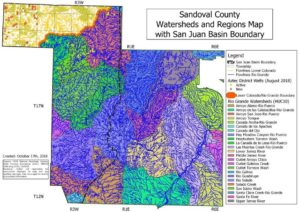
There is a blatant failure by the BLM to delineate, or portray precisely the Eastern San Juan Basin’s complex hydrology. This area is on the southeastern edge of the San Juan Basin and is adjacent to, or part of, a strong geological uplift area that is characterized by complex folded layers known as the Nacimiento Uplift. BLM has not included watersheds surface and groundwater flora and fauna impacted, in the Lower Colorado (Watershed Yellow area in NW corner map (above) of Sandoval County), Espanola Basin Sole Source Aquifer Designation, the Rio Grande AKA Santa Fe Sub Basin Group, and San Juan Basin. All comingling of the waters between surface and groundwater should be taken into account since there is reliance on groundwater for drinking water source in nearly 80 % of New Mexico. These considerations are paramount in the RMP along with a full EIS of the area, The poisoning of drinking water resources and supplies by the extensive fracking and drilling outside the geological boundary of the San Juan Basin is most likely to destroy groundwater sources.  Both hydrological and geological studies should be made public and evaluated in the RMP before approving and launching online lease sales when they will not accept online public comments.
The BLM 2003 Plan and associated Reasonably Foreseeable Development Plan, DOES NOT ADDRESS FRACKING IN THE MANCOS SHALE, A LAYER FROM 0-5000 FEET BELOW THE SURFACE, SOME OF WHICH OVERLIES GROUNDWATER. THIS IS NOT CONSIDERED A PREFERRED OR NECESSARILY SAFE GEOLOGIC STRUCTURE TYPE FOR FRACKING.
The BLM has an internal administrative policy that allows this use of outdated documents until a new one is prepared. What about the option of a deferral of drilling until the 2003 Resource Management Plan is properly updated?
CHEMICALS– many chemicals are used in fracking; some known, some not – most are toxic or can be radioactive at low levels. Radium found naturally in lower rock levels would be contained in rocks, even if brought to the surface. However, Radium turns in a radioactive gas called Radon, and that will be dispersed into the air. The Brine water will also contribute to a larger waste stream within the Region that is radioactive agents of uranium and full of lead, arsenic and other heavy metals and minerals and VOCs. This is another waste stream additional to the fracking operations that will impact the region with the use of Sandoval County Raw Brine and injection of highly radioactive produced water.
BLM should take seriously the comments on the RMP tests, survey results, and statements by Tri-Chapter leaders regarding the health and safety impacts experienced by many residents who live on trust lands and private lands. We have not seen any public statement on what the BLM intends to consider regarding the Tri-Chapter complaint. The BLM also will need to consider the migrating pollution plumes of air and water on other jurisdictions. This outreach is crucial to a collaborative citizen engagement, which is key to good public administration.
SEISMIC ACTIVITY– Has not been sufficiently considered in the Watersheds impacted, not in the Lower Colorado Watershed, Espanola Basin Sole Source Aquifer Designation, the Rio Grande AKA Santa Fe Sub Basin Group, and San Juan Basin where there are several known fault lines near our water sources and in the geological formation of the Rio Grande (Nacimiento) Rift. Injection wells are often used to dispose of wastewater and these are known to cause seismic activity. There is also increasing evidence in New Mexico, Texas and Oklahoma that fracking is associated with significantly more earthquakes.
AIR QUALITY AND CLIMATE CHANGE– Flaring is a common practice used in fracking in which huge amounts of hydrocarbons are released directly into the atmosphere. A 3- 12 miles radius near flaring pits has been identified as dangerous to human and animal health. In 2014, scientists working on a NASA study discovered a 2,500-square-mile cloud of methane hovering over the Four Corners region. The BLM seems to dismiss this as being of unknown origin, although recent studies clearly indicate that oil and gas development is the largest source of emissions contributing to this massive methane “hotspot”. Environmental health studies have found impacts of respiratory illnesses up to 10 miles from fracking wells, according to the peer-reviewed studies by Physicians for Social Responsibility.
BLM AND CLIMATE CHANGE 
The BLM attempted to rescind the Obama Administration Rules and now is under court order to address climate emissions from this industry and other environmental and public health and safety issues. We face an onslaught with over 50,000 parcels scheduled for lease sales from oil and gas extraction, fracking and drilling, in the region and the BLM is now required to consider emissions.Case 4:16-cv-00021-BMM Document 111 Filed 03/26/18 Page 1 of 52
  1. RMP Development under FLPMA 
The Federal Land Policy and Management Act of 1976 (“FLPMA”) directs the Secretary of the United States DOI, through BLM, to “manage the public lands under principles of multiple use and sustained yield.” 43 U.S.C. § 1732(a). BLM accomplishes this directive by developing, maintaining, and revising RMPs. 43 U.S.C. § 1712(a); 43 C.F.R. § 1601.0–5(n). RMPs “guide and control future management actions.” 43 C.F.R. § 1601.0–2. RMPs establish “[l]and areas for limited, restricted or exclusive use” and determine “[a]llowable resource uses (either singly or in combination) and related levels of production or use to be maintained.” 43 C.F.R. § 1601.0-5(n)(1)–(2).
BLM should “coordinate the land use, inventory planning, and management activities” for lands covered by an RMP. 43 U.S.C. § 1712(c)(9). BLM should coordinate these activities “with the land use planning and management programs of other federal departments and agencies of the States and local governments within which the lands are located.” Id. BLM obtains this federal, state, and local
cooperation in the RMP process by inviting relevant state and local governments and federally recognized Indian tribes to participate as “cooperating agencies.” 43 C.F.R. § 1610.3–1(b). BLM provides cooperating agencies with “opportunity for review, advice, and suggestion on issues and topics that may affect or influence other agency or other government programs.” 43 C.F.R. § 1610.3–1(c).
RMP approval represents a major federal action that significantly affects the quality of the human environment. 43 C.F.R. § 1601.0–6. RMP approval triggers the preparation of an Environmental Impact Statement (“EIS”) under NEPA. Id. The EIS and RMP shall be “published in a single document” whenever possible. …
Pg 48 Claim #5 An EIS must provide “a full and fair discussion of significant environmental impacts.” 50 C.F.R. § 1502.1. This discussion must be based on “high quality” information and “accurate scientific analysis.” 40 C.F.R. § 1500.1(b). BLM violated NEPA where it failed to justify its use of GWPs based on a 100-year time horizon rather than the 20-year time horizon of the RMPs. BLM also violated NEPA where it failed to acknowledge evolving science… 
The BLM, in the entirety of the 50,000 + parcels is REQUIRED TO DO AN RMP/EIS.  We request that the RMP/EIS cover every Lease Sale that the BLM has scheduled in its entirety before conducting the any online or “in-person” lease sales in December 2018 and beyond.
SOIL RESOURCES– in this high desert climate, the soil can be fragile. Our concerns for the soil in light of heavy traffic from big rigs used in fracking; the traffic and erosion caused by roads and construction of drilling pads; toxic chemical spills and the hauling of water have caused in other counties in the nations that have similar populations. The EPA and State authorities state that in some areas soils are fragile, but this is of “minor concern due to the remoteness of parcels”. In other words, out-of-sight is out-of-mind, if they can’t see it, it doesn’t matter. Surely, this is not the message the BLM wants to be sending.
WILDLIFE– The endangerment of the particular species to the BLM of the specifics species endangers in these areas, and the disruption of migratory patterns, etc. Here is a list of species candidate, threatened and endangered:
      Yellow-billed Cuckoo -Coccyzus americanus -Bird Candidate
      Rio Grande cutthroat trout- Oncorhynchus clarki virginalis- Fish Candidate
      New Mexican meadow jumping mouse- Zapus hudsonius luteus -Mammal Candidate
      Southwestern willow flycatcher- Empidonax traillii extimus- Bird Endangered
      Rio Grande silvery minnow- Hybognathus amarus- Fish Endangered
      Black-footed ferret- Mustela nigripes- Mammal Endangered
      Mexican spotted owl- Strix occidentalis lucida- Bird Threatened
      Plus Migratory birds and animals
Wastewater pits, with indeterminate lining, are another means of disposing of fracking’s toxic sludge.
1.) What are the provisions to keep birds and animals from drinking, or landing in, the open pit storage water?
2.) What assurance that each parcel application has been inspected for threatened and Endangered Species?
DARK SKY–NOISE. The BLM has not inserted from the hours of previous comments, the protection of the night sky and protection from noise in rural settings and is a taking of property values that impact health and safety of its citizens.
CULTURAL RESOURCES AND LANDSCAPES of Indigenous Nations and Tribal Communities are not being appropriately addressed.  Here is a map of Wells in question that has not been adequately addressed that are in violation of the buffer zone. Those wells that breach of the buffer zone should be included in an expanded boundary to include the watershed and boundary edge of the SE San Juan Basin of the Lower Colorado.
Our suggestion is to enter into a formal collaboration with tribal communities on trust lands and those on private lands being impacted by the BLM decision.  Mediation on collaboration is needed because the BLM actions have shown its inability to address the process adequately.
LOW SOCIOECONOMIC POTENTIAL FROM OIL AND GAS– The BLM’s assumption if there is a “No Action Alternative” (no lease option) in the environs of impacted watersheds.  IN OTHER WORDS, IF THERE IS NOT ENOUGH OIL AND GAS TO BE OF ANY REAL COMMERCIAL VALUE, then why move forward without a socio-economic cost-benefit analysis or fiscal impact analysis. The BLM barreling towards oil and gas exploration at grave risks of chemical and mechanical pollution without proper notification and not allowing a longer time for public comments exposes a corrupt closed process that will rubber stamp oil and gas production with FONSI’s.
The INFRASTRUCTURE required for oil and gas production has not been addressed nor has its impacts on the environment including pipelines, compressor stations and gathering lines.  The systemic segregation of a seating of heavy industry in places of pristine wilderness and rural minority communities without a master plan oversight of over 50,000 oil and gas parcels; sets to deceive the public on the scope of the heavy industrial onslaught that BLM is set to approve without giving our communities the right to be properly informed and engaged in the decisions regarding our land, our communities, and the future development from economic development to community development. The struggle for land rights continues for Native American, traditional Hispanic and low -income communities.
The costs of inspections, mitigation, and cleanup including road repair always fall on the taxpayers.  BLM has not informed the public of what costs will burden them when there are not enough inspectors on the current operating and abandon wells. Currently, a well is inspected once in 5 years.  Many of the inspection reports have shown that the inspectors could not have inspected the number of wells in a day they say they had due to time, distance, and issues reported.
INADEQUATE response to issues
Infrastructure concerns – Pipelines, Compressor stations, gathering lines
No regs on road closures
No regs on gathering lines
No emergency response plan was given to community
No public health concerns addressed
No road impact fees
No lighting regulations
Did not require better noise standards
Not enough impact fees on erosion control
No operational restrictions,
No requirements on produced water and injections that may cause seismic activity in known thermal areas
No requirements on the type of Water used
No requirement for additional air monitoring of schools inside and outside air quality.
No Real-time air monitoring for oil and gas particulates including FLIR Cameras to report real-time emission violations on fracking rigs.
HEALTH CONCERNS–According to peer-reviewed studies, (already submitted previously to the BLM), respiratory illnesses from fracking operations healthcare costs would soar upwards to $275,000 a day. Are the BLM administrators aware of types of illnesses that are currently being experienced and the impact on the minority community in order to address these health issues?
IN CLOSING – 
BLM’s definition of  “environmental justice refers to the fair treatment and meaningful involvement of people of all races, cultures, and incomes, with respect to the development, implementation, and enforcement of environmental laws, regulations, programs, and policies. It focuses on environmental hazards and human health to avoid disproportionately high and adverse human health of environmental effects on minority and low-income populations.”  BLM appears to violate their own regulations through an insider policy decision that are driven by the current administration’ s disregard for the rule of law, and its a racist implementation of a policy that disproportionately impacts economics, the health and safety of the communities adjacent to and in the parcels being sold.  These are regional impacts. How does BLM plan to address these issues after they commit genocide and ecocide by their decisions?
The observations of citizens regarding the BLM’s disregard for environmental justice issues and the lack of appropriate action to wait for NEPA and the RMP only adds to the disdain for the government of an agency that is supposed to protect the land, water, air, and uphold the public health and safety. Instead, BLM is implementing a policy of genocide and amount of over 50,000+ parcels of lease sales slated surmounts to a crime against humanity.  Additionally, there has been no concern for the emissions that are drivers for climate change that these lease sales would impact in light of the recently released IPCC report.
Please defer any lease sale until the RMP and EIS are complete and BLM has fully addressed the concerns with a formal Environmental justice investigation regarding the disparate impact of the seating of the heavy industry expansion in the region.
Sincerely,
Elaine Cimino
Ecimino10 (at) gmail.com
Commongroundrising.org  Citizens Group

Geology presentation on the Rio Grande Basin

This article was first publish on www.commongroundrising.org/blog  in January 2018 that has important infomration and is the basis of the Sandoval County Citizens Working Group (CWG) Science Ordinance that is currently being hacheted by the  County Commissioners. Don Phillips a geologist for the oilnad gas industry stepped forward as a citiznes to help the area protect drinking and is now a target by NMOGA, who has also targeted this blog. 
Don Phillips has been making rounds with his presentation on the geology of the Upper Rio Grande, Albuquerque Basin.
Don Phillips Geologist Former mayor of Fairview Texas Presentation of the Geology of the Upper Rio Grande
This video presentation that was given to the County Commision and the Natural Resource Committee of the All Pueblo Council of Governors, who graciously allowed the presentation for educational purposes. These meetings were designed to spread the word to our elected officials and now the public.  This is a candid discussion of the issue of hydraulic fracking from a perspective of an oil and gas expert and geologist.  It was science that they listened to that helped vote down the ordinance in December. This gives us a bit of hope that there are solutions to moving forward.
For over the past month several people from various groups have met to discuss a vision for moving forward.  After discussions with several civic leaders and citizens groups, it was apparent that there was a need to present a proposal to the County Commission and surrounding stakeholders area. We are have worked with several groups to compose a Final Draft Resolution For Stakeholders Regional Plan
If there was ever a perfect example of the need for the right of nature to exist, it is now in the Rio Grande Valley.
The future of life as we know it is at risk, and this is because the logic of maximum profit for the benefit of the few has been imposed on a finite planet with limited and fragile resources. Over-exploitation, excessive mineral resource extraction, over-consumption and unbridled waste are altering the vital cycles of nature. It is essential that we recover our humanity and end this logic of commodification and privatization imposed by capitalism. We need to strengthen and recover our indigenous roots of respect for Mother Earth. We must listen to the scientific community that alerts us to the interdependence of all elements of the Earth system. And we must create – and recreate – economic models that preserve the regenerative capacity of nature. In short, it is urgent that we share and embrace the essence of the rights of Mother Earth.
“We, the peoples and nations of Earth: considering that we are all part of Mother Earth, an indivisible, living community of interrelated and interdependent beings with a common destiny…”

Oil and Gas Drilling in Sandoval County: Rio Puerco Desalination Project Timeline on Raw Brine Use for Fracking

The timeline on the Sandoval County/IMH/Aperion Recorp Desalination Project that may use the deep raw brackish/brine for Hydraulic Fracturing in In Sandoval county and beyond. 
What started out as a master plan desalination project has quickly turned to the use of raw brine for fracking in Sandoval County. Information obtained in IPRA request on Sandoval County role, as a public and private partnership, with Aperion ReCorp (now IMH Hedge Fund)  and several other shell corporations out of Arizona. These are foreign corporations that are now ligating to see who will control the New Mexican Brackish water resources that Sandoval County appears to have given away.  The market value for the water alone is said to be over $1 Billion, according to a couple of appraisals obtained.
The cost of the building $87 Million with bonds that the State, Feds, and Sandoval County residents would be responsible for.  But what is worse is to see how this deal was made, who is responsible for it and what we can do as citizens. How do we get accountability for money spent? How will this water be used in the future?  The questionable practices to obtain funding for this project and the implication of corruption, sidestepping administrative rules calls into question the ethics of the administration of Planning and Zoning Director and the current County Manager on this project. What was to be a desalination project is now opening the door to raw brine use for fracking operation in the Sandoval County Area.
Will using brine water for fracking ruin the health of our communities and drinking water in our region? In 2009 the second attempt to use the brine for oil and gas development seemed like an ecological solution than using fresh water.  HB0019 passed in 2009 Sponsored By Mimi Stewart. A prior attempt to pass a vague bill in 2007 was voted down. The HB0019 Fiscal Impact Report from the Legislature can be found here.
On July 30, we discovered the documents that show the interconnection between the desalination pumping in the Rio Puerco impacts on the Rio Grande. At the July 12 Work session of the Sandoval County Commission, New Mexico Tech stated there was no study they could find on transmissivity or interconnection between the two basins. Yet this study was paid for by the Interstate Stream Commission. This study was covered up and was not given to the County Commission and or the District Court or the NM Supreme Court Case that could have been much different had they known about how these impacts of pumping 18,000 – 43,000 acre-feet a year would impact the Rio Grande Compact. The reason for the discrepancy is that there are different documents that claim this ability on paper water rights and when adding up the various partners invested in IMH Financial Corporation. Impacts to Rio Rancho Water Supply has also been discussed because of the fractured nature of the geology in the area and the multiple wells planned for the project.
In the July 12th Work Session the Thrust Energy experts and its CEO stated their intention of fracking on the West Mesa out Southern Blvd out to the Rio Puerco and said that their Documentation was proprietary and they were not able to show us why they thought Mancos Shales operations and oil drilling were of exceptional quality.
As it stands there are no regulations on brine/brackish water and the fracking operators can drill with unpolished brine water. We believe that despite adamant denials from Gary Lee, an engineer on the desalination project, that the brine will be used for fracking. However, The authorization letter by the OSE hammers the last nail in the coffins for impacts to the Rio Grande and the ability for fracking operations to withdraw water that could pump the Rio Grande Dry.
OSE Final_2018_Letter_Authorization_RG-88934.  The current status of the brine wells (2) was repaired and the OSE now has authorized the record of repair of the wells. Sandoval County and IMH may now pump on those wells and selling raw brine for fracking operations.
NMED is reviewing the discharge Permit for Desal project and if approved can later be modified as the waste stream on these wells impact the environment, water, air wildlife and impact the health of our communities. the Salt in the Brackish water has a 13,000 TDS (Total Dissolved Solids) that include heavy metals, Radionuclides, and arsenic just to name a few. There are Plans for selling the lime and salt waste as Gypsum Board. Sandoval County has an offer from Lhoist.
According to email communication between Mike Springfield and George King, they planned to get then State Engineer to support legislation on pre-emption of the beneficial use on drilling under 2500 ft.
What pours salt into our wounds is that the brackish water will be used for Fracking the 100,000 Acres of Public and Private lands causes impacts to Shallow drinking water aquifers and causing more Emissions when we should be keeping it in the Ground. The project has been appraised at 1 billion dollars and they sold their share for $6 Million. This is putting profit before people and the Earth and is unacceptable, in light of Climate change and the human genocide.

Public Comments on Sandoval Oil and Gas Ordinance

If the County wanted to create districts by watershed and overlay various restrictions to protection water, they would have a scientific bases to do this. It would allow people within these watershed baoundaries to decide the restrictions. However, all these colorful watershed are part ofthe Rio Grande watershed. Only the yellow gold area in the northwest sector is part of thee lower Colorado basin. This is what good public participation looks like and what good government would do. this approach may be a way to meet the intentions of the Pueblo and Dine' communities for the needed protections against pollution from hydraulic fracturing and conventional drillling.
Sandoval County Commissioners,                                       October 28, 2018 
I am a resident of Rio Rancho in Sandoval County, NM; this is a Public Comment on the Oil and Gas Ordinance that I wish to appear in full on the record for the County Commission to consider. The issues in front of the County Commission are many regarding the writing and implementation of the Oil and Gas Ordinance. Here are the concerns we have:
The County can but does not appear to be willing to insert the needed protections where they have jurisdiction, on what is not preempted by State and Federal authority, into the ordinance.  
WATER– While water quality issues are being addressed in the Science Citizens Working group ordinance; it only pertains to specific districts within the ordinance itself.
BRINE/BRACKISH WATER– The County has not commented regarding the use of and its impacts Brackish/Brine would have on the shallower drinking water aquifers when a breach occurs. The Shoemaker Report of 2008-2013 of the Deep Water Brine wells was submitted in the oil and gas public comments two months ago. This report shows brine well impacts on the Rio Grande and the shallower wells, especially the drinking water wells in Rio Rancho, according to the OSE authorization letter.
The County has not disclosed:
  • Their fiscal interest to the public on its private partnership with IMH Financial Corp partners in the Rio West Desalination Project;
  • This entity has mineral rights to frack and drill. What are the County’s fiscal interests in those mineral rights?
  • The County, agreed to a settlement agreement 12-30-2010, it will receive 4,000 acre-feet a year (AFY) to sell industrial water; What is the potential interest?
  • On 12-14-2018 there is an expected $6M, the part of the sum the county spent on water development and the Rio West Desalination Pilot Program,
  • This is not including the costs of road creation, repair, and maintenance, which was to be provided by the developers.
  • Why has the County not processed any of the Pilot Project fiscal information and agreement through the County Clerk’s office or Treasures office? Why was the property taxes in Rio West assessed they way it was?
These are one of many of the items that the County has not disclosed, but the County is moving forward without addressing them.
1.)  The IMH Financial Corp Partnership will not have to polish the brackish/brine water to sell industrial water as “raw brine” for fracking and drilling once a pump is installed.
a.) This brackish brine water could be sold to fracking operators for the 40,000 mineral leased parcels on public lands being approved by federal authorities, as well as, for other community uses that have not been defined. The County complicit in the impacting of the private, public, trust and tribal lands onslaught of health safety and environmental degradation, not only the private lands under its jurisdiction. Is the County aware of this?
2.) The County could hold IMH to the intent of project by setting a standard of polished effluent for water sold.
a.) MOU between the State and EPA regarding recycling and green-washed use of fresh, produced and Brackish/brine finite waters of New Mexico does not address quantity or quality issues and what a breach of and or blow would cause to groundwater in the area. OSE and NMED have a limited jurisdiction but the intent of the project lies within the Rio West Master Plan and County ordinance jurisdiction.
Our suggestion is that the Commission demand that their Planning and Zoning Department follow the intent of the approval of the Master Plan for desalination, not sell raw brine and that any changes of the product produced would need to be approved by the county commission regarding the desalination project. 
ENVIRONMENTAL JUSTICE –CIVIL RIGHTS 
According to the environmental justice advocate, Richard Moore, “We believe that every New Mexican regardless of race, ethnicity, or class has a right to be properly informed and engaged in the decisions regarding our land, our communities, and the future development from economic development to community development. The struggle for land rights continues,” for Native American, traditional Hispanic and low -income communities.  Districting also is seen as a segregation issue being played out within the Sandoval County ordinance. This is not only troubling; it is an indication of systemic bias within the county government. It would not be hard to lodge a federal complaint to address a decades-old system of discrimination where more affluent communities are protected and low-income minority communities are left out of the process and how local government and developers make decisions for them. Sandoval County is already under a corrective action order on Native American voting rights violations. The County has a track record of discrimination.
In accordance with Title VI of the Civil Rights Act of 1964, each Federal agency shall ensure that all programs or activities receiving Federal financial assistance that affects human health or the environment do not directly, or through contractual or other arrangements, use criteria, methods, or practices that discriminate on the basis of race, color, or national origin.
Any Federal and State funding may be jeopardized and the County would be held responsible for implementing an ordinance of this nature, according to the ordinance drafts being presented for discussion and final approval.
Title VI of the Civil Rights Act prohibits recipients of federal financial assistance (states, grantees, etc.) from discriminating based on race, color, or national origin in any program or activity.
Executive Order 12898, on the other hand, directs federal agencies to identify and address, as appropriate, disproportionally high adverse human health and environmental effects of their programs, policies, and activities on minority populations and low-income populations.
However, a Title VI civil rights complaint may raise environmental justice issues when challenging a recipient’s activity. For instance, if a state agency receives funds from EPA to run a clean air program, that state recipient is legally prohibited from discriminating on the basis of race, color or national origin under Title VI when engaging in clean air enforcement activities.
The EPA, in complying with Executive Order 12898, can also ensure the programs it funds consider disproportionately high adverse human health and environmental effects on minority and low-income populations.
This includes the land use protections of health and safety that they are not addressing. The County is using “permissive use” restricting and disenfranchising environmentally impacted minority communities in the NW Section of Sandoval County. Follow-up comments by current County Commissioners are troubling in regarding the questioning of health and safety concerns voiced by Tri-Chapter tribal leaders. These comments indicate a deep bias against Indigenous and Hispanic communities in the Northwest Sector of the Sandoval County when their concerns are dismissed and they are disparaged publicly. (Rio Rancho Observer article 10-20-18)
We are proposing a collaborative community development structure. 
Public Participation and Notification Meanwhile, the County is not allowing public comment, in a public hearing, prior to the final approval of the ordinance.
  • Past actions by the Sandoval County Planning and Zoning on the Sandridge Application when the county accepted online public comments, that were put into an unscannable pdf.  Several commissioners said they never read or considered those comments submitted online because of the sheer volume of email against the fracking attempt in the ABQ basin.
  • The County has opened public comment online but this holds many questions as to citizens’ comments being a legitimate record on the issue.
  • According to complaints to the Commission, there are complaints that are missing that were submitted. The Commission by not allowing Public Comments prior to a final approval of the ordinance disenfranchises community participation, with their actions that will permanently impact the lives of residents, and further disallows members of the public the opportunity for redress of a taking in district court, appears to be a violation of due process and civil rights.
CHEMICALS– many chemicals are used in fracking; some known, some not – most are toxic or can be radioactive at low levels. Radium found naturally in lower rock levels would be contained in rocks, even if brought to the surface. However, Radium turns in a radioactive gas called Radon, and that will be dispersed into the air. The Brine water will also contribute to a larger waste stream within the County that is radioactive agents of uranium and full of lead, arsenic and other heavy metals and minerals and VOCs. This is another waste stream additional to the fracking operations that will impact the region.
The County has letters of interest from Lhoist who has indicated that they would like to make gypsum board from the “lime” sludge waste from the desalination process—This waste stream is dangerous and needs more oversight.
The County should take seriously the tests, survey results, and statements by Tri-Chapter leaders regarding the health and safety impacts experienced by many residents who live on trust lands and private lands. We have not seen any public statement on what the County intends to consider regarding the Tri-Chapter complaint despite the occasional visit to Chapter meetings. The County attempts have indicated the County’s intentions only. There has not been a reciprocal collaboration, which should be a collaborative and mediated process.
BASELINE TESTING is needed prior to application approvals. The County should start this now.
SEISMIC ACTIVITY– Has not been sufficiently considered in the ABQ Middle Rio Grande Basin Rio Puerco and Watershed not in the Lower Colorado Watershed and San Juan Basin where there are several known fault lines near our water sources and in the geological formation of the Rio Grande Rift. Injection wells are often used to dispose of wastewater and these are known to cause seismic activity. There is also increasing evidence in Texas and Oklahoma that fracking is associated with significantly more earthquakes. A couple of the Ph.D. UNM Seismologists would be willing to come present but those efforts have been stopped by the Sandoval Commission and planning department during 2017 -2018. The NM Tech supplement report did not adequately address this issue.
AIR QUALITY AND CLIMATE CHANGE– Flaring is a common practice used in fracking in which huge amounts of hydrocarbons are released directly into the atmosphere. A 3- 12 miles radius near flaring pits has been identified as dangerous to human and animal health. In 2014, scientists working on a NASA study discovered a 2,500-square-mile cloud of methane hovering over the Four Corners region. The County seems to dismiss this as being of unknown origin, although recent studies clearly indicate that oil and gas development is the largest source of emissions contributing to this massive methane “hotspot”. Environmental health studies have found impacts of respiratory illnesses up to 10 miles from fracking wells, according to the peer-reviewed studies by Physicians for Social Responsibility previously submitted to the County). The County has not drawn up a Climate Change Ordinance to address climate emissions for this industry and other environmental and public health and safety issues, as we face an onslaught of fracking and drilling in the region.
The County appears to be ignoring many things in its rush to push a fictitious deadline to pass an inadequate ordinance.
SOIL RESOURCES– in this high desert climate, the soil can be fragile. Our concerns for the soil in light of heavy traffic from big rigs used in fracking; the traffic and erosion caused by roads and construction of drilling pads; toxic chemical spills and the hauling of water have caused in other counties in the nations that have similar populations to Rio Rancho and Sandoval County Urban, Semi-Urban and Rural Roads. Local County and City jurisdictions may spend up to $40 million a year. (See attached the Cost of Fracking Study) The EPA and State authorities state that in some areas soils are fragile, but this is of “minor concern due to the remoteness of parcels”. In other words, out-of-sight is out-of-mind, if they can’t see it, it doesn’t matter. Surely, this is not the message the Commission wants to be sending.
WILDLIFE– The Endangerment of the particular species to the County of the specifics species endangers in these areas, and the disruption of migratory patterns, etc. Here is a list of species candidate, threatened and endangered:
  • Yellow-billed Cuckoo -Coccyzusamericanus -Bird Candidate
  • Rio Grande cutthroat trout- Oncorhynchusclarki virginalis- Fish Candidate
  • New Mexican meadow jumping mouse- Zapus hudsoniusluteus -Mammal Candidate
  • Southwestern willow flycatcher- Empidonaxtraillii extimus- Bird Endangered
  • Rio Grande silvery minnow- Hybognathusamarus- Fish Endangered
  • Black-footed ferret- Mustela nigripes- Mammal Endangered
  • Mexican spotted owl- Strix occidentalislucida- Bird Threatened
  • Plus Migratory birds and animals
Wastewater pits, with indeterminate lining, are another means of disposing of fracking’s toxic sludge. There are open pits used in fracking, and there are new toxic evaporation ponds in the Rio Puerco waiting for a discharge permit from NMED, which should be out soon for public comment.
1.)  What are the provisions to keep birds and animals from drinking, or landing in, the open pit storage water in the ordinance?
2.)   What is the ordinance insertion that gives assurance that each parcel application has been inspected for threatened and Endangered Species?
DARK SKY–NOISE. The County has not inserted from the hours of previous comments given in the previous ordinance in 2017, the protection of the night sky and protection from noise in rural settings. The current suggestion from PZ Director is his opinion rather from scientific data. Therefore not allowing the correct insertion in the ordinance is a taking of property values of its citizens.
CULTURAL RESOURCES AND LANDSCAPESOf Indigenous nations and Tribal Communities are not being appropriately addressed. After an eloquent public comment from Tribal leaders at the 10-18-18 regular session of the County Commission; 
1.) The county commission ignored what was said and moved forward with an ordinance timeline without appropriate comment and consultation;
2.) When Pueblo leaders told the Commission that Nov. 1st was not possible a date for their attendance and further impute because of their ceremonial obligations, the Commission ignored this request and schedule a meeting on November 1stdespite their requests.
3.) These inactions are an embarrassment to County residents because they have ignored conversations, emails, and comments and are moving forward with a bad ordinance.
Our suggestion is to enter into a formal tribal consultation and collaboration with tribal nations. Mediation on collaboration is needed because the County has shown its inability to address the process adequately and should take up the offer of Regis Pecos at the 10-18-18 meeting.
LOW SOCIOECONOMIC POTENTIAL FROM OIL AND GAS– The County Commission assumption if there is a “No Action Alternative” (no lease option) in the environs of impacted watersheds within the county.  IN OTHER WORDS, IF THERE IS NOT ENOUGH OIL AND GAS TO BE OF ANY REAL COMMERCIAL VALUE, then why move forward without a socio-economic cost-benefit analysis. The NM Tech Supplement did not provide a sufficient analysis. Yet the County is barreling towards oil and gas exploration at grave risks of chemical and mechanical pollution without public comments, will be rubber stamping oil and gas production by the Planning and Zoning Director through permissive use, seriously exposing the County to legal actions.
The INFRASTRUCTURE required for oil and gas production has not been addressed nor has its impacts on the environment including pipelines, compressor stations and gathering lines.  Ordinance language from local communities who also face preemption was submitted to Commissioner Heil during the process and was ignored.
The Paseo Del Vulcan (ABQ by-pass) now becomes heavy industrial roadway being paid for by the taxpayers, instead of the heavy industry being slated and seated in the regional area. The County is paving the way for crony developers to buy up frontage road along the route. This includes past action of the City of Rio Rancho annexing ranches in the area to bring the by-pass into the middle of the City. This appears to be agreements made with developers, ranchers and oil and gas industry in backroom deals, putting more tax burdens on property owners.
There have been transparency violations filed on how the bonds were approved without proper public notification. Many existing roads in Rio Rancho and the County have been ignored for many years when the bond was pulled putting Rio Rancho and the County 10-20 years behind on maintenance, repair, and replacement.  Property owners now see a major highway proposed while many existing roads lay in disrepair.  This will get worse if fracking operations are allowed access without substantial impact fees. The County does not have a cost-benefit, or fiscal impact analysis to take into account the taxpayers’ cost of environmental cleanup, roads, etc. as described in this document.
INADEQUATE language in the following areas of the Ordinance:
Infrastructure concerns – Pipelines, Compressor stations
No regs on road closures
No regs on gathering lines
No emergency response plan — We were trying to work with the County Commissioners Holden Rhodes, Heil and Eichwald back in January to form a LERC to write a plan, but the commissioners buried our request. Relying on Industry to implement and enforce it has shown not to work.
No public health concerns in the ordinance
No road impact fees
No lighting regulations
Did not require better noise standards
Not enough impact fees On erosion control
No operational restrictions,
No requirements on produced water
No requirements on the type of Water used
No requirement for additional air monitoring of schools inside and outside air quality.
No Real-time air monitoring for oil and gas particulates including FLIR Cameras to report real-time emission violations on fracking rigs.
HEALTH CONCERNS–For the record several physicians that wished to give testimony have been stopped by the County Commission and the Planning Department. Physicians for Social Responsibility and other health professionals have not had the opportunity to testify under oath to the Commission and enter into the record the statistics of respiratory illnesses that occur in communities with populations similar to Rio Rancho.  According to peer-reviewed studies, (already submitted previously to the County), respiratory illnesses from fracking operations healthcare costs would soar upwards to $275,000 a day.  Can the County afford these types of expenses considering the health programs they already fund?
OPEN MEETING ACT (OMA) VIOLATIONS– We have filed an OMA complaint on every meeting the County has held on the oil and gas ordinance and the bonds issues that included the road issues in the past 2-3 months.  The OMA violations occurred because of insufficient listings of agendas bond items, rolling quorum, lack of attachments and meetings minutes, notification of time, place and date, the disenfranchising of the public comments in the process by continually holding a hearing where people are not allowed access or to comment because they are holding the hearing in chambers too small to contain the interested public.
The County’s reliance on overflow seating is a problem in the atrium is poor sound quality and it doesn’t allow for public comment on any other agenda item or on the particular agenda item being heard. They do this on a continual basis despite offers by the Bernalillo mayor to facilitate crowds in a larger forum so those interested in speaking and attending the meeting in person can show their interest on an issue. It is unfair to the citizens of the County, does not allow them to redress, it chills public participation, creates apathy and disdain for the government on the issues that impact their lives and violates due process. Much has been corrected because of our filing of the OMA Complaints but despite the County efforts that we still have problems. Currently, there are several complaints in front of the OAG for determination.
IN CLOSING – 
Our suggestion would be to discuss this ordinance with the firm that wrote the Santa Fe and Mora County ordnances’, discuss passing a moratorium, request a moratorium to continue safely to develop this ordinance with both citizens working groups. Set up a reporting and development during the moratorium period, which allows the final product to be vetted. This would not be starting over, it would be taking the ordinance we have and delineating the issues with them and vetting what is legal ending with a quality protective ordinance.
Right now the commission needs to engage in Tribal Consultation and Collaboration and allow the process to be done correctly. The Sandoval tribes, in the APCG and Tri-chapter area, have supported moratoriums while is the ordinance process.
This ordinance is for the protection of the people and property in Sandoval County.
The Commission has not allowed public comment in a public hearing, to air this proposal to them as a possible solution to the challenges in front of them. We are in this together but that is not what the County’s message has been to those in or not in the CWG.
Instead, we are watching another train wreck.
There is a full onslaught of over 40,000 parcels on public lands in the Rio Chama, Rio Grande, Chaco Canyon, and the Greater Chaco areas up for public mineral leases. It is in the Greater Chaco area where health impacts are being experienced. People there have grave safety concerns that need to be addressed. The county ordinance would help adjacent private landowners fend off environmental impacts being ignored by federal and state regulatory agencies.
The County is not in a position to rely on staff that has no previous experience with writing and implementing the oil and gas ordinance, to the extent of the issues presented in Sandoval County, including tribal consultation. Our suggestion is to contact, Kate Ferlic, Law Firm ( California Planning Firm) and pay professional legal planners fees to bring forward an ordinance similar to the Mora and Santa Fe ordinance to save taxpayers the cost of legal actions that are sure to follow if the county continues with its current process.
Sincerely,
Elaine Cimino
Ecimino10 (at) gmail.com
Kate Ferlic 123 West San Francisco, Suite 200, Santa Fe, NM 87501 | 505.986.9641 (California Planning firm which did the Santa Fe and Mora County Ordinance)